
Many organizations are shifting from building traditional centralized data centers to deploying distributed, edge-cloud-centric “centers of data.” Your enterprise’s legacy network and security infrastructure was not designed for this. It has become overly complex, difficult to manage, inefficient, and costly. Siloed compute and storage, disjointed network and security architectures, and manual operations make central orchestration and policy control harder every year. Modernizing your data center networking around the following five design principles closes that gap.
1. Modernize Data Center Networking With DPU-Enabled Switches
CPUs and GPUs have long carried the processing load, but data processing units (DPUs) now offload traffic handling so your compute-intensive workloads get the resources they need. DPUs once lived only on servers. They are now available in top-of-rack switches, pairing standards-based Ethernet switching with programmable, hardware-accelerated services such as encryption, firewalling, NAT, and telemetry. These data center solutions require no changes to server hardware or software and no agents on your hosts; you can add them to existing brownfield environments. HPE Aruba Networking and AMD Pensando introduced the industry’s first distributed services switch in 2022, the CX 10000 Series.
2. Adopt an Intent-Based Networking Architecture With Fourth-Generation Distributed Services
Hyperscalers learned a decade ago that a separate appliance for every service does not scale. They built functions into a single operating system managed by one automated controller, which let them support millions of workloads. A fourth-generation fabric brings that consolidation to your environment. Instead of bolting services onto each VM and chaining appliances together, you apply them at the fabric edge, closer to your applications. This approach can reduce latency, cut appliance sprawl, and remove the licensing and CPU costs of server agents.
Also, it fits naturally with an intent-based networking architecture, where you define the outcome you want and let automation translate it into consistent policy across the fabric. Best of all, you can start at the top-of-rack leaf switch and migrate one rack or POD at a time, avoiding a disruptive forklift upgrade.
3. Extend Zero Trust Across Your Data Center Solutions
Zero Trust assumes an attacker may already be inside, so no entity or traffic is trusted unless policy explicitly allows it. In the data center, that means stateful inspection of east-west traffic to stop lateral movement. Traditionally, this required discrete appliances and VMs outside the fabric, forcing traffic to hairpin across the network and adding challenges between your networking and services teams.
Embedding these controls in the fabric changes the economics. HPE reports that a distributed services architecture delivers 100x the scale and 10x the performance at a third of the TCO of traditional solutions, based on internal analysis. DXC Technology used the CX 10000 as the foundation of its secure network fabric, replacing hundreds of virtual and physical firewalls and projecting 83 percent TCO savings. When you evaluate data center solutions for segmentation, ask where enforcement happens and how many boxes it takes.
4. Blend Network and Security AIOps Into Your Intent-Based Networking Architecture
Your AI and machine learning tools are only as good as the telemetry feeding them. Many teams rely on probes, agents, and TAP aggregation networks that capture sampled snapshots, not the complete, high-fidelity data automation needs. This leaves blind spots and adds failure points.
A distributed services fabric generates accurate telemetry natively across the entire data center. That lets you automatically detect anomalies, group them into related incidents, and feed your SIEM, SOAR, XDR, and AIOps platforms through REST APIs. Your network team also gains a time machine to look back at any flow and quickly find root causes, proving whether the network is at fault. Pairing this data with an intent-based networking architecture lets you compare what is happening against what you intended, so your engineers act on insight instead of raw metrics.
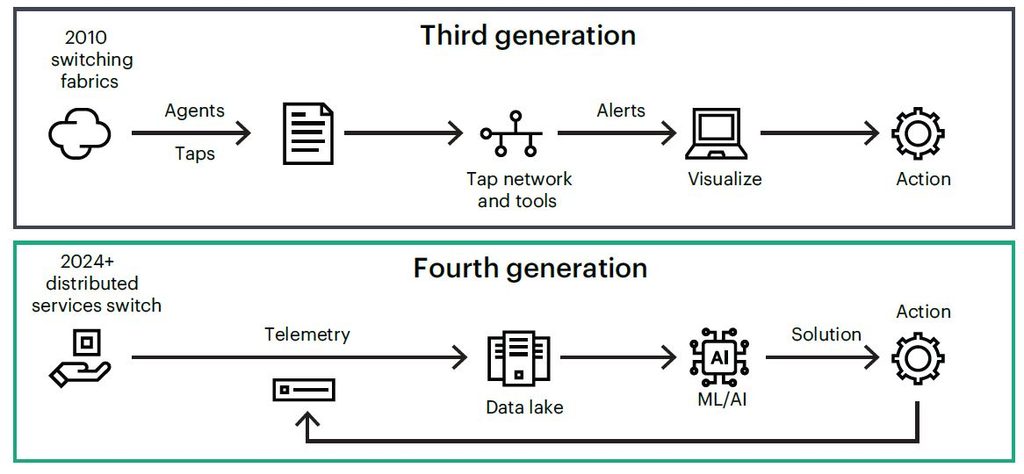
Figure Source: Five design principles for a smarter data center, HPE
5. Leverage the Edge, Colocation, and IaaS for Data Center Solutions
Data is increasingly generated on factory floors, in retail sites, healthcare facilities, and smart buildings. Application placement now drives infrastructure decisions, and hybrid cloud spanning public cloud, edge, colocation, and on-premises locations is your reality. Colocation paired with an as-a-service model offers low-latency connections to major cloud providers, no up-front payments, no egress charges, and a single contract and invoice. A Forrester study found that customers who deployed HPE GreenLake reported up to 80 percent faster time to market on complex global IT projects. Extending your data center networking to the edge with these consumption models lets your staff pivot from running infrastructure to delivering new services.
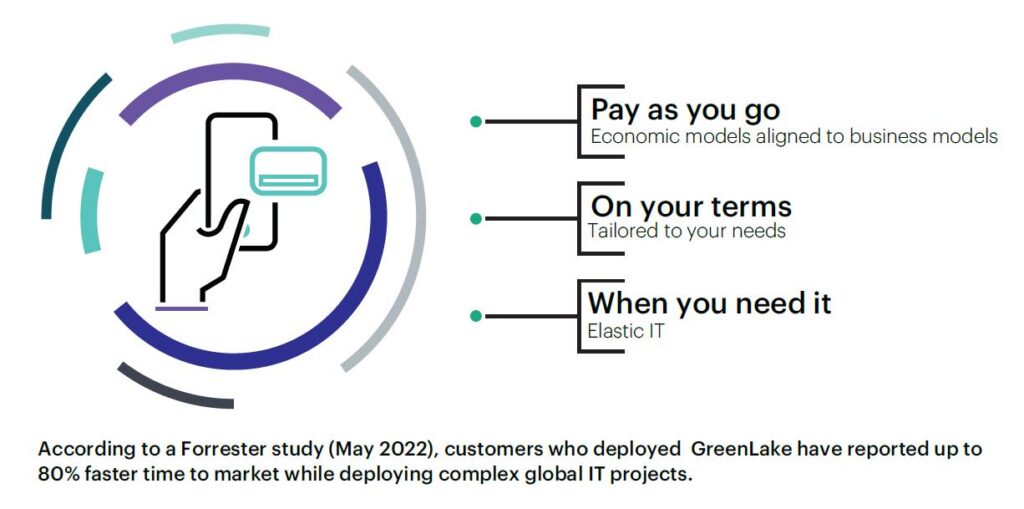
Figure Source: Five design principles for a smarter data center, HPE
Final Thoughts
Adopting these principles takes more than technology: it takes design discipline, a phased migration plan, and operations that can use an intent-based networking architecture and AIOps with confidence. WEI brings deep expertise in modernizing networks, and as your AI infrastructure partner, WEI helps you validate designs and sequence upgrades without disrupting production. Our AI infrastructure consulting for enterprises starts with the environment you run today, and our best enterprise AI integration services connect that foundation to automation and AI-driven operations. Together, these steps accelerate AI time to value across every site you manage. Contact WEI to build a data center strategy ready for distributed data.
Next Steps: Seventy-percent of of enterprises experienced an increase in workload security posture within the data center after deploying CX data center switches. To meet the challenges of the data explosion, the data center must be reimagined and redesigned to handle next-gen requirements. HPE Aruba Networking’s data center solution powers unified, intelligent, and automated software-defined fabrics providing what’s needed to support modern, next-generation edge-to-cloud centers of data. Download our free tech brief to learn more.
READ: Take The Next Step With Automated Data Center Solutions