

This is Part 3 of WEI’s Hybrid Truth Blog Series. Be sure to read Part 1 and Part 2. In Part 4, we’ll translate RTO, RPO, and downtime into a financial model your CFO can support. WEI guides organizations to build a stronger business case for cloud-based disaster recovery.
For decades, disaster recovery meant paying for infrastructure you hoped you would never need. Organizations built secondary data centers, duplicated hardware, and carried ongoing operational costs simply to prepare for a scenario that might never occur.
Today, that model no longer makes sense for most businesses. Cloud has transformed disaster recovery from a costly insurance policy into a scalable operational capability that can evolve alongside the business. Organizations can now build resilience with greater flexibility, faster recovery, and significantly better economics than traditional secondary-site approaches.
DR Is No Longer Just About Recovery
Disaster recovery (DR) is often viewed as a safety net. In reality, it has become a strategic architectural decision. The same cloud platforms that power modernization initiatives, analytics workloads, and application transformation have also become the foundation for backup, replication, failover, and business continuity.
That matters because DR is no longer only an IT concern. It is a business resilience issue. Executives increasingly want answers to questions such as:
- How quickly can critical systems be restored?
- How much data could be lost during an outage?
- What would downtime actually cost the business in lost revenue, operational disruption, customer experience, and brand reputation?
Cloud is particularly effective because it allows organizations to align resilience requirements with business needs rather than the budget of a second physical data center. Teams can start small, prove value, and mature their recovery architecture over time without major capital investment.

DR and BCP Are Related, But Not the Same
Disaster recovery and business continuity planning are often used interchangeably, but they answer different questions.
Disaster Recovery (DR) restores IT systems and data. It is the technical playbook for recovering servers, applications, infrastructure, and information after a disruption. Recovery objectives are measured through metrics such as Recovery Time Objective (RTO) and Recovery Point Objective (RPO).
Business Continuity Planning (BCP) is the broader organizational strategy that defines how the business continues operating while recovery efforts are underway. This includes alternate work locations, manual processes, employee communications, vendor continuity, and operational workarounds.
Put simply, DR answers “How do we recover our systems?” while BCP answers “How does the business keep operating in the meantime?”
Key Takeaway: DR answers how systems recover. BCP answers how the business continues operating while recovery takes place.
A strong disaster recovery strategy is one pillar of a broader business continuity plan, not a replacement for one. This article focuses on the DR side of the equation because cloud has fundamentally changed what is technically and economically possible. However, the RTO and RPO decisions discussed throughout this article ultimately serve as inputs into the larger continuity strategy every organization should maintain.

Recovery Is Increasingly About Cyber Resilience
While natural disasters and infrastructure failures remain important considerations, many modern recovery events are cyber-related.
Ransomware attacks, accidental deletion, software corruption, configuration errors, and malicious insiders account for a growing percentage of business disruptions. In many cases, the infrastructure itself remains operational, but the data can no longer be trusted.
This changes the disaster recovery conversation. Organizations are no longer planning only for a facility outage. They are planning for situations where they must rapidly recover clean data and restore business operations with confidence.
Cloud-based recovery architectures that incorporate immutable backups, isolated recovery environments, and validated restoration procedures have become critical components of modern resilience strategies.
For highly regulated industries, recovery strategies must also support compliance requirements around retention, immutability, auditability, and recovery validation. The ability to demonstrate recoverability is becoming just as important as the ability to recover itself.

The Core DR Models
Not every application requires the same recovery approach. The best DR strategies begin by classifying workloads according to business impact and then matching them to an appropriate recovery model.
1. Backup and Restore: The simplest and least expensive option. Data is backed up regularly to cloud storage, and systems are rebuilt from those backups if an incident occurs. Recovery times are typically measured in hours or even days. Best suited for lower-priority systems where extended downtime is acceptable.
2. Pilot Light: A minimal version of the environment remains active in the cloud, often consisting of core databases and configuration services. Additional compute resources are deployed only when recovery is required. This approach significantly reduces recovery time while maintaining relatively low operational costs.
3. Warm Standby: A scaled-down but fully functional version of the production environment runs continuously. When failover occurs, the environment scales to meet production demand. Warm Standby often provides the best balance between recovery speed and cost for business-critical applications.
4. Multi-Site Active/Active: The highest level of resilience and typically the highest level of investment. Production workloads operate simultaneously across multiple locations, with traffic distributed between them. Because both environments are already active, recovery is effectively immediate. This approach is generally reserved for mission-critical systems where downtime carries substantial financial or operational impact.
The right answer is the model that aligns with the actual business consequences of downtime for that particular workload.

Recovery Models Across the Cost and Recovery Spectrum
The graphic below illustrates how disaster recovery strategies progress from Backup & Restore to Active/Active architectures. As recovery objectives become more aggressive, the investment required to achieve them also increases.
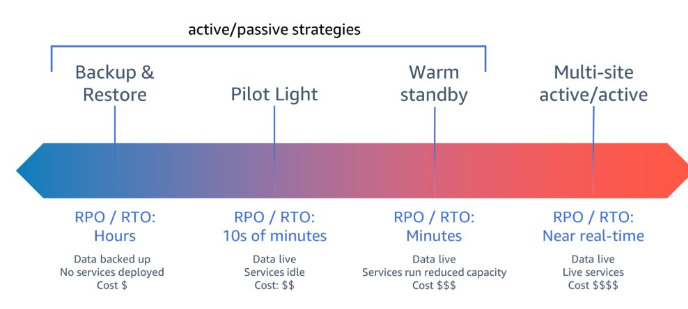
Figure 1: Disaster recovery models mapped against recovery objectives, operational complexity, and relative cost.
Cloud’s Economic Advantage
One of the biggest misconceptions organizations have about disaster recovery is that every workload deserves the highest level of protection.
In reality, most environments contain a mix of systems with very different business requirements. A file archive, development environment, ERP platform, customer portal, and manufacturing control system rarely require the same recovery approach.
One of the greatest advantages of cloud-based DR is the ability to align investment with workload importance. Development systems, departmental applications, and archival workloads may only justify Backup and Restore protection. Customer-facing business systems may warrant Warm Standby or Active/Active architectures.
Cloud enables organizations to apply the appropriate level of protection to each workload rather than overbuilding recovery infrastructure for everything.
Defining RTO and RPO Before You Design Anything
Before choosing a recovery model, every workload should have two critical metrics defined:
- Recovery Time Objective (RTO): How quickly the system must be restored after a disruption.
- Recovery Point Objective (RPO): How much data loss, measured in time, the business can tolerate.
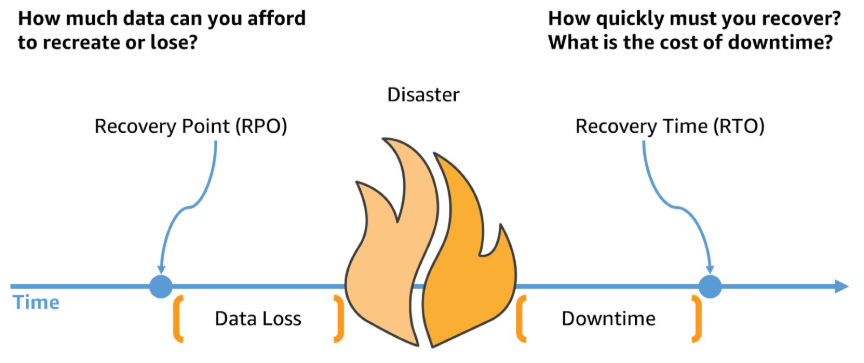
Figure 2: Recovery Point Objective (RPO) defines acceptable data loss, while Recovery Time Objective (RTO) defines acceptable downtime following a disruption.
These two metrics drive every architectural decision that follows. While they are often discussed as technical measurements, they are ultimately business decisions.
RPO defines how much data an organization can afford to lose. RTO defines how long the business can operate before a system must be restored. Together, they establish the recovery requirements that drive backup frequency, replication strategy, architecture design, and overall DR investment.
For example, if an ERP platform processes thousands of dollars in orders every hour, an RTO of 24 hours may be unacceptable. Similarly, if losing four hours of transactional data creates financial, regulatory, or customer-impact concerns, a four-hour RPO may not be viable.
The key point is that RTO and RPO are not technical decisions. They are business decisions translated into architecture.
A workload requiring near-zero data loss and recovery within minutes will typically demand Warm Standby or Active/Active architectures. Workloads with less stringent requirements can often be protected effectively through Pilot Light or Backup and Restore approaches.
Too many DR strategies are built backward. Organizations choose a recovery technology first and then try to force business requirements to fit the architecture. Defining RTO and RPO before design begins keeps recovery investments aligned with actual business needs.
We’ll explore the financial impact of these metrics in greater detail in Post 4 of this series.
Why Hybrid Cloud Is Making DR More Practical
One of the biggest trends we’re seeing is the continued growth of hybrid cloud architectures.
Despite aggressive cloud adoption initiatives, many organizations continue to operate a mix of on-premises infrastructure, colocation resources, private cloud, and public cloud services. Rather than viewing this as a temporary state, many businesses are embracing hybrid as their long-term operating model.
For these organizations, cloud often becomes the ideal disaster recovery destination.
Instead of maintaining a fully equipped secondary data center, organizations can replicate critical workloads from their on-premises environment into AWS or Azure and consume cloud resources only when recovery is required. This dramatically lowers infrastructure costs while providing geographic separation, scalable capacity, and modern automation capabilities.
In many ways, hybrid cloud has become one of the most practical disaster recovery approaches available because it allows organizations to improve resilience without requiring a full cloud migration. Organizations preserve investments in existing infrastructure while leveraging cloud economics and resiliency services to improve business continuity.
For many organizations, the cloud is replacing the need for a secondary data center.
What a Cloud DR Architecture Actually Looks Like
The most effective recovery environments have one thing in common: recovery is automated, repeatable, and documented. The goal is to remove human improvisation from the recovery process wherever possible.
A modern cloud DR architecture typically includes:
- Automated backup orchestration: Centralized policies govern backup frequency, retention, encryption, and recovery across databases, virtual machines, and storage.
- Cross-region or cross-cloud replication: Data and configuration are replicated to separate geographic regions to eliminate single points of failure.
- Infrastructure as Code (IaC): Recovery environments are defined and version-controlled just like production environments, making deployments predictable and repeatable.
- Automated failover and failback processes: Monitoring, health checks, and orchestration reduce reliance on manual intervention during critical incidents.
- Network and identity continuity: DNS, routing, authentication, and access controls are designed to function seamlessly during failover.
The implementation details may differ between AWS, Azure, or hybrid-cloud environments, but the underlying principles remain the same: automate recovery, replicate across failure domains, and build infrastructure from code rather than memory.
The Most Overlooked Step: Testing
A backup or DR environment that has never been tested is not actually a DR strategy. It’s an assumption.
Recovery plans do not fail during planning meetings. They fail during real incidents, when organizations discover a dependency was never replicated, a runbook is outdated, credentials have expired, or a critical application was overlooked entirely.
Cloud has dramatically simplified testing compared to traditional secondary-site models. Recovery environments can be spun up, validated, and removed without disrupting production or waiting for a maintenance window.
Organizations that mature their DR capabilities treat testing as an operational discipline rather than an annual compliance exercise.
Testing is also the only reliable way to validate whether the RTO and RPO targets defined during planning can actually be achieved under real-world conditions. Recovery objectives that have never been tested are simply assumptions until proven otherwise.
For critical systems, quarterly validation should be considered the minimum standard.
The 3-2-1 Rule Still Applies
Even with advanced cloud-native resiliency capabilities, the fundamentals remain important. The 3-2-1 rule continues to provide a strong foundation:
- 3 copies of your data
- 2 different storage systems or media types
- 1 copy stored off-site
Within cloud architectures, that off-site copy is commonly maintained in a separate region or recovery environment. Modern DR strategies should build on this principle, not replace it.
The Bottom Line
Disaster recovery has evolved from a secondary data center problem into an architectural decision.
Organizations no longer need to choose between resilience and cost. Cloud and hybrid architectures make it possible to align recovery capabilities with actual business requirements, protect critical systems appropriately, and continuously improve recovery readiness as environments evolve.
The most successful organizations start by understanding what the business can realistically tolerate in terms of downtime, data loss, and operational disruption. From there, they build recovery strategies that are automated, tested, and designed around those requirements.
Whether your environment is fully cloud-based, entirely on-premises, or somewhere in between, the fundamental principles remain the same:
- Define business-driven RTO and RPO objectives.
- Match recovery models to workload criticality.
- Automate wherever possible.
- Test regularly.
- Treat resilience as an ongoing process, not a one-time project.
The question is no longer whether your organization needs disaster recovery. The question is whether your recovery strategy reflects how modern businesses operate. If you would like to begin assessing this strategy, please reach out to the WEI cloud team directly.
Next Steps: WEI’s Cloud Health Check validates, benchmarks, and optimizes your cloud workloads against AWS and Azure Well-Architected best practices — delivered by WEI’s certified cloud engineers. Whether you’re running on AWS, Azure, or a hybrid multi-cloud environment, WEI tailors the review to your specific platform.
Download our free solution brief to better understand our assessment process and the benefits your enterprise IT operations can gain from it.
Solution Brief: WEI Cloud Health Check